
Our story
When you become a parent,
you start reading the backs of things.
Not because you're obsessive. Because something shifts. The jar of balm you never thought twice about. Now you're holding it up to the light, counting ingredients, googling the ones you can't say out loud.
One new dad. One jar he couldn't find.
When our son was born, my wife was the one actually at the changing table.
Which meant she was the one reading every label. She's careful that way, more careful than me honestly. She'd pick something up, flip it over, put it back. Pick up the next one. Something about every single option made her uncomfortable, and she couldn't always name exactly what. That feeling is worth paying attention to.
The expensive one had 30 ingredients and cost $40 and came with no explanation of what half of them were or why they were there. The drugstore one led with petrolatum, petroleum derivatives refined to less stringent standards than EU markets require, and called itself "Pediatricians #1 Choice" on the front.
She'd look at me and say: there has to be something better than this.
I took that as a brief.
Then the test results started coming out.
In September 2025, independent testing found lead in HealthyBaby's diaper cream. An EWG Verified product. The same testing found lead in Babo Botanicals, also EWG Verified, also MADE SAFE certified. In Honest Company. In Burt's Bees Baby. In Desitin Extra Strength at 3,303 parts per billion. Washington State's legal limit is 1,000 ppb. The product labeled "Pediatricians #1 Choice" exceeded it by more than three times.
The parents in those comment threads all said the same thing: "I've been using this on my baby for five months. I thought I was using the safest thing on the market."
The thread connecting every single contaminated product: zinc oxide. Zinc mined from the earth carries trace heavy metals. It doesn't matter what else is in the formula. It doesn't matter what certification is on the label. If the zinc is contaminated upstream, the cream is contaminated at your changing table. A single-formulation test can pass. Then a supplier changes. The next batch doesn't.
There is no safe level of lead exposure for a five-month-old.
Independent lab results, 2025
-
Desitin Extra Strength
3,303 ppb lead
"Pediatricians #1 Choice" -
HealthyBaby Diaper Cream
Lead + cadmium detected
EWG Verified -
Babo Botanicals Diaper Cream
Lead + cadmium, among highest detected
EWG Verified + MADE SAFE -
Coco Balm
No zinc oxide. No lead pathway.
Tested every batch.
Source: Lead Safe Mama independent testing, Sept–Dec 2025. Washington State Toxic-Free Cosmetics Act limit: 1 ppm (1,000 ppb) lead.
What if you just didn't use zinc?
Not as a shortcut. As a real choice.
Zinc oxide is the active ingredient in diaper rash treatments. It forms a physical barrier over seriously irritated skin. For a bad rash, a pediatrician and a zinc-based cream is still the right answer, and we'll always say so directly.
But you don't need zinc for the daily ritual. The post-bath application, the preventive layer at every change, the dry spot on your toddler's cheek. For that you just need something clean that works. And if you're honest about what clean actually means, you don't need 30 ingredients to do it.
The answer was five things.
Every one of them something you've heard of. Every one of them something you could look up in thirty seconds and feel good about.
No petrolatum. No lanolin. No mineral oil. No fragrance, including the "natural" kind. No essential oils. No zinc. No preservative, because an anhydrous formula has no water in it, and water is what needs preserving.
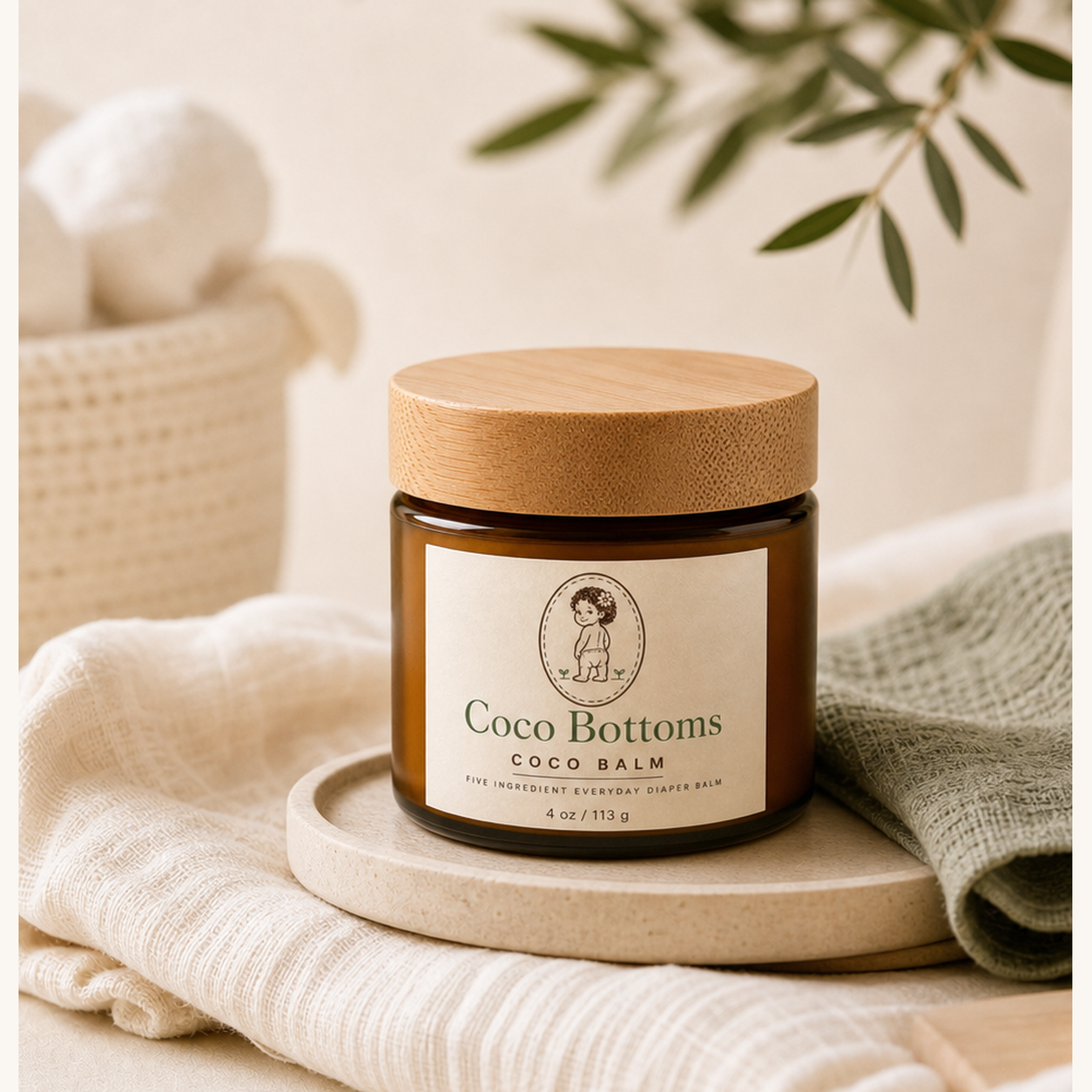
It comes in a 4 oz amber glass jar because every plastic container, tube, and bottle leaches microplastics into what's inside it. Glass doesn't. No liner. No off-gassing. No microplastics migrating into what goes on your baby's skin. You can see the product. Nothing is hidden.
- Virgin coconut oil Cold-pressed. The hero. Most of the jar.
- Beeswax Structure and a breathable barrier. Replaces petrolatum.
- Sunflower wax Heat-stable so it won't liquefy in a warm nursery.
- Jojoba oil Closest to skin's own sebum. Spreads warm, absorbs clean.
- Colloidal oatmeal 1%. Skin-soothing. The one line that needs a comma.
We test every batch. Not just at formulation.
HealthyBaby tested their formula. Then their supplier changed. The formula looked identical on paper. The heavy metals weren't. A clean ingredient list is the first layer of trust. Batch-by-batch testing is the second.
Every production run of Coco Balm is tested by an independent third-party lab for lead, cadmium, mercury, arsenic, and PFAS before it ships. We publish the results. If a batch fails, it doesn't go out.
- PFAS: non-detect
- Heavy metals: below FDA limits
- Lead + cadmium: tested every batch
- Made in USA, small batches
I made this because she couldn't find it. Neither of us could.
She was the hardest critic we had. She used it on our son before I showed it to anyone else. She told me when the texture was wrong, when a batch smelled faintly of something she didn't trust, when it was too stiff in cold weather. She didn't let me call it done until she was satisfied.
Five ingredients she could read out loud. A glass jar with nothing to hide. A test result for every production batch.
She said yes. That was the green light.
People tell us it ends up on their nightstand. That their partner started using it. That they haven't bought separate hand cream in months. One woman told us she uses it on her lips every morning on the way to work.
Five ingredients clean enough for a newborn. One jar that ends up being everyone's.
Ben, founder of Coco Bottoms
Mom-tested. Mom-approved. (The original mom is very particular.)